

RocketReach Reviews: Is It Legit? Pricing, Features & Verdict
We tested RocketReach’s email and phone lookups, broke down its real per-seat pricing, and cross-checked hundreds of verified G2 and Capterra reviews to answer the question everyone searches for first — is RocketReach legit, and is it worth it for B2B sales in 2026?
What Is RocketReach?
RocketReach is a cloud-based B2B sales intelligence and contact data platform founded in 2015 by Amit Shanbhag and Andrew Tso, and headquartered in Bellevue, Washington. It gives sales reps, recruiters, and marketers a searchable database of over 700 million professional profiles and 35 million companies, with verified email addresses, direct-dial and mobile phone numbers, and social profile links surfaced in a single lookup.
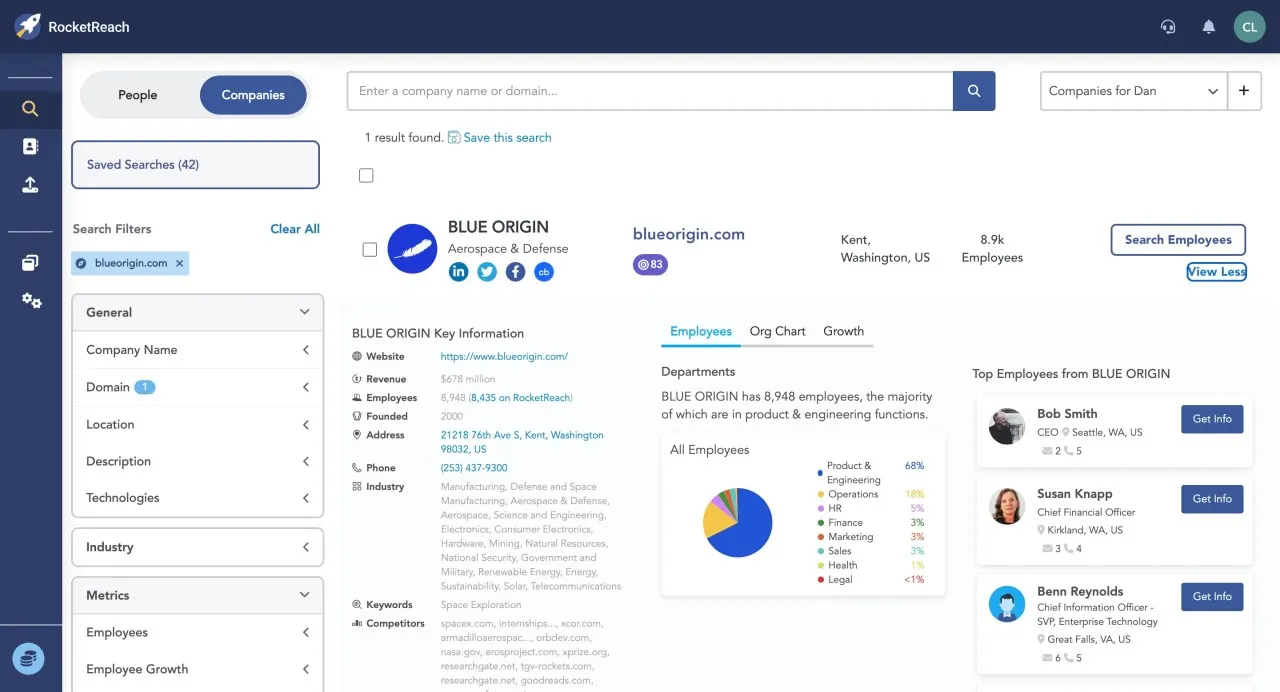
The platform built its early reputation on a Chrome extension that pulls contact details straight off a LinkedIn profile or company website, and that one-click workflow is still the feature most reviewers mention first. Around that core lookup tool, RocketReach has layered an AI-assisted search bar that accepts natural-language queries (“VP of Marketing at Series B SaaS companies in Texas”), bulk list building, a lightweight outreach/sequencing tool, and native integrations with Salesforce, HubSpot, Outreach, and Zapier.
RocketReach positions itself between free-tier email finders like Hunter and enterprise platforms like ZoomInfo — a broad database and AI-driven search at a published, self-serve price point, rather than the quote-only enterprise contracts that dominate the top of this category.
Key Features of RocketReach
RocketReach’s feature set centers on lookup and search, with AI, integrations, and outreach tools layered around that core. Here’s what matters most to the majority of buyers.
700M+ Contact Database
Searchable profiles across 35M+ companies, with email, direct-dial, and mobile numbers surfaced per contact.
Chrome Extension
One-click contact lookup directly from a LinkedIn profile or company website, without leaving the page.
AI Search Assistant
Natural-language prospecting queries translate into filtered searches instead of manual filter-stacking.
Bulk Lookup & Lists
Upload a list of names or domains and enrich them in batch, then organize results into saved lists.
CRM & Workflow Integrations
Native connections to Salesforce, HubSpot, Outreach, and Zapier push enriched contacts straight into your stack.
100+ Search Filters
Firmographic and technographic filters — revenue, headcount, tech stack, funding — for narrower targeting.
Basic Outreach Tool
Send templated emails and track opens/replies to newly found contacts without a separate sequencer.
Developer API
Programmatic access to lookups on Pro and Ultimate for teams building enrichment into their own tools.
Real-Time Verification
Emails are checked at the time of lookup rather than served from a static, aging cache.
RocketReach’s AI Assistant, Explained
Because “RocketReach review B2B sales AI” is one of the more common searches around this tool, here’s the short version. RocketReach’s AI search layer sits on top of its existing filter engine — you type a plain-language description of the buyer you want, and it maps that request onto the platform’s firmographic and role-based filters automatically. It’s a convenience feature for faster query-building, not a separate AI model generating new contact data; the underlying records still come from RocketReach’s own database and verification pipeline. Treat it as a faster way to search, not a data-accuracy upgrade in itself.
Is RocketReach Legit?
Yes — RocketReach is a legitimate, established company, not a scam or a fly-by-night data broker. It was founded in 2015, has raised outside funding including a growth investment from Brighton Park Capital, and operates with a real corporate headquarters in Bellevue, Washington. RocketReach states it is used by over 21 million professionals and by a large majority of S&P 500 companies for sales, recruiting, and marketing outreach, and it maintains active, verified review profiles on both G2 and Capterra with well over a thousand combined reviews.
Where the “legit” question gets more nuanced is around two specific, repeated complaints rather than any suggestion of fraud:
- Data accuracy variance — RocketReach advertises a high accuracy rate for verified emails, but a meaningful share of reviewers report real-world hit rates in the 70–90% range for email and noticeably lower for phone numbers, alongside a reported 20–30% bounce rate on some lookups.
- Billing and cancellation friction — multiple 2025–2026 reviewers describe annual plans auto-renewing without a clear reminder, and difficulty getting a refund when a plan renews unused. This is a billing-process complaint, not evidence the company is illegitimate, but it’s common enough to plan around.
Our take: RocketReach is legitimate and safe to use for B2B contact lookup — treat it the way you would any contact-data vendor, with email verification on your side before a cold outreach send, and set a calendar reminder before your annual renewal date.
RocketReach Pros & Cons
Based on our review of aggregated G2 and Capterra feedback plus hands-on testing of the free and Pro tiers — here’s an honest breakdown.
✅ What RocketReach Does Well
- Large, broad database — 700M+ profiles across 35M+ companies
- Published, self-serve pricing instead of ZoomInfo-style quote gating
- Well-regarded Chrome extension for one-click LinkedIn lookups
- AI-assisted natural-language search speeds up query building
- Free tier available with no card required to start
- Native Salesforce, HubSpot, Outreach, and Zapier integrations
- Simple, uncluttered interface that’s easy to onboard new reps onto
❌ Where RocketReach Falls Short
- Data accuracy is inconsistent — outdated titles and stale numbers are the top complaint
- Real-world bounce rates reported around 20–30% on email sends
- Free tier’s 5 lookups is evaluation-only, not a working free plan
- Paid plans require annual billing for the advertised per-seat rate
- Export caps limit how many contacts you can push to a CRM per year
- Auto-renewal and cancellation friction show up repeatedly in reviews
- Customer support response times draw regular criticism
RocketReach Pricing Plans (2026)
RocketReach runs a free tier plus three self-serve, per-seat plans, with a custom Enterprise tier above that. Prices below reflect RocketReach’s published annual-billing rate as of August 2026; monthly billing is available at a meaningfully higher effective rate.
Free
- 5 lookups total
- 1 user
- Email lookup only
- No card required
Essentials
- $329/year per seat
- Email lookups only
- ~1,200 exports/year
- Chrome extension
Pro
- $829/year per seat
- Email + phone lookups
- ~3,600 exports/year
- CRM integrations, API access
Ultimate
- $1,699/year per seat
- Email + phone, highest limits
- ~20,000 exports/year
- Priority support
Is RocketReach Worth the Price?
This depends heavily on how much you value phone data and how many contacts you need to export into a CRM per year. Essentials is genuinely budget-friendly for email-only prospecting, but the moment your team needs direct-dial or mobile numbers, Pro becomes the realistic entry point at roughly $829 per seat annually. Export caps are the detail most buyers miss at signup — Essentials’ 1,200-export annual ceiling works out to just 100 CRM-ready contacts a month, which a busy SDR can burn through quickly.
💡 Our take: Budget for Pro rather than Essentials if phone numbers matter to your outreach motion, and confirm your team’s monthly export volume against the plan caps before committing to annual billing — upgrading mid-contract isn’t available the way it is with monthly SaaS tools. If enterprise-grade phone verification is non-negotiable, compare pricing against dedicated sales intelligence platforms before you buy.
Pricing reflects RocketReach’s published self-serve rates as of August 2026, billed annually per seat. RocketReach periodically adjusts pricing and export caps — confirm current rates on RocketReach’s official pricing page before you buy.
RocketReach Ratings Breakdown
We aggregated scores from G2 and Capterra and normalized them across the dimensions that matter most to sales and recruiting teams evaluating a contact-data vendor.
RocketReach holds a 4.4/5 on G2 from over 1,000 verified reviews and a 4.1/5 on Capterra, rising to roughly 4.3/5 among small-business users specifically. Ease of use and database size are consistently the strongest-praised dimensions; data accuracy and billing clarity are consistently the most-cited weak points across both platforms.
What Real Users Are Saying About RocketReach
A summary of the range of aggregated, verified feedback that sales and recruiting professionals report on G2 and Capterra.
Values the Chrome extension for pulling verified emails straight from a LinkedIn profile without breaking the research flow, and says it’s replaced two separate tools on the team’s stack.
Runs a small recruiting agency and appreciates the flat, published pricing compared to the quote-only competitors evaluated first, though wishes phone coverage was more consistent outside the US.
Says the search filters and interface are genuinely easy to learn, but flags a noticeably higher bounce rate on exported emails than the advertised accuracy figure suggested.
Had a frustrating experience getting a refund after an annual plan auto-renewed, and recommends setting a calendar reminder well ahead of the renewal date.
RocketReach vs Competitors
RocketReach competes primarily with ZoomInfo, Apollo.io, Hunter.io, Lusha, and Cognism. Here’s how it stacks up on the factors that matter most for B2B sales and recruiting buyers.
| Tool | Starting Price | Pricing Model | Free Plan | Best For |
|---|---|---|---|---|
| RocketReach Reviewed | $27/mo | Per seat, annual | 5 lookups, no card | Affordable AI-assisted lookup |
| ZoomInfo | Custom quote | Custom, per seat | No | Enterprise sales intelligence |
| Apollo.io | ~$39/mo | Per seat, annual | Yes, generous tier | All-in-one prospecting + sequencing |
| Hunter.io | ~$34/mo | Credit-based | Yes, limited searches | Email finding & verification |
| Lusha | ~$36/mo | Per user, credits | Yes, limited credits | Lightweight extension lookups |
| Cognism | Custom quote | Custom, per seat | No | Phone-verified EU mobile data |
RocketReach vs ZoomInfo — Which Is Better in 2026?
This comes down to budget and data-depth requirements. ZoomInfo offers deeper firmographic intelligence, intent data, and a much larger dedicated support and data-verification operation — but it’s sold entirely through custom quotes that typically run well into five figures annually for a small team. RocketReach’s published per-seat pricing means a solo rep or small agency can start prospecting the same day for under $30 a month. If your team needs enterprise-grade intent signals and org-chart data, ZoomInfo justifies its price; if you’re optimizing for cost-per-contact on a smaller budget, RocketReach is the more accessible starting point.
RocketReach vs Apollo.io
Apollo and RocketReach sit closest together on price and audience. Apollo’s strength is its built-in sequencing and dialer, making it closer to an all-in-one outbound platform; RocketReach’s strength is raw database breadth and its well-regarded Chrome extension for one-off lookups. Teams that want prospecting and outreach in a single tool tend to prefer Apollo; teams that already have a sequencer and just need a reliable contact-lookup layer tend to land on RocketReach.
RocketReach vs Hunter.io
Hunter is narrower by design — it’s an email-finding and verification specialist, not a full sales-intelligence platform, and its accuracy guarantees are generally viewed as tighter than RocketReach’s. RocketReach adds phone numbers, a much larger contact database, and CRM integrations that Hunter doesn’t attempt to match. If email deliverability is your top priority and you don’t need phone data, Hunter’s narrower focus can mean fewer bounces; if you need one platform covering email, phone, and firmographic search, RocketReach covers more ground.
Who Is RocketReach Best For?
✅ Great Fit For
- Freelancers, small agencies, and solo founders on a tight budget
- SDR teams that already have a sequencer and just need reliable lookups
- Recruiters sourcing candidate contact details at scale
- Teams comparing RocketReach against pricier tools like ZoomInfo
- Anyone who wants published, self-serve pricing over a sales call
✗ Not Ideal For
- Enterprises needing intent data or deep org-chart intelligence
- Teams with strict low-bounce-rate deliverability requirements
- Buyers who want month-to-month billing without an annual commitment
- EU-focused teams needing phone-verified mobile coverage
- Teams that want built-in multichannel sequencing in the same tool
Frequently Asked Questions
The most common questions about RocketReach — answered honestly based on our research and verified user reviews.
Final Verdict: Is RocketReach Worth It
After testing RocketReach’s search and Chrome extension, cross-referencing its published pricing, and reviewing aggregated verified user feedback, our verdict is straightforward: RocketReach is a legitimate, affordable entry point into B2B contact data, provided you go in expecting real variance in data accuracy and a firm annual billing commitment.
For freelancers, small agencies, and budget-conscious sales teams, RocketReach’s published pricing and large database deliver genuine value over quote-only enterprise platforms, and the AI-assisted search makes it faster to build targeted lists than manual filter-stacking. For teams that need enterprise-grade accuracy guarantees, deep intent data, or flexible monthly billing, the gap versus ZoomInfo or Cognism is real — budget and plan accordingly.
Before committing: Run a small batch of lookups against contacts you can already verify before buying an annual plan, and decide upfront whether you need phone data — that single decision determines whether Essentials or Pro is the realistic starting tier.